

One of the largest heat pumps in the world has reached BASF's Ludwigshafen site
- 95 tons in weight, 16 meters long: The core of one of the most powerful industrial heat pumps has arrived at BASF’s Ludwigshafen site
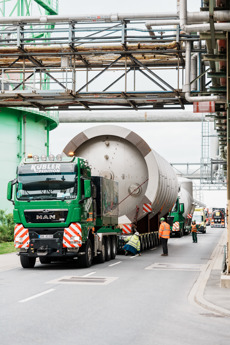
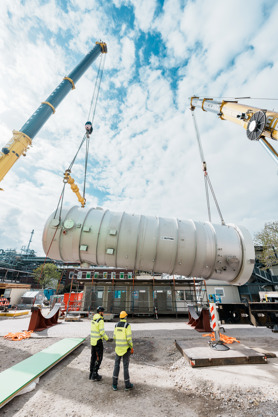
One of the largest components for the construction of BASF’s heat pump at the Ludwigshafen site has traveled several hundred kilometers via waterways – the 95‑ton so-called plate falling-film evaporator was shipped from Schwedt on the Oder River to the port of the chemical company’s main site. From there, it was transported as heavy-haul truck across the plant premises to the construction site for the heat pump at the steam cracker, where the key component is now being installed.
The plant currently under construction will be one of the most powerful industrial heat pumps for emission‑free steam generation worldwide. The falling‑film evaporator plays a central role in this: It is only within this unit that steam is generated that no longer contains oxygen, thereby meeting the ideal conditions for use in industrial plants. The process steam produced here is then fed through the site-wide Verbund network to the production plants, where it serves as an energy carrier.
With the successful delivery of the plate falling‑film evaporator, a major logistical step within the project has now been completed. The roughly 16-meter-long component was designed by BASF’s project partner GIG Karasek. The Austrian company is also primarily responsible for constructing the heat pump. Together with BASF, the majority of the plant components were specially adapted for the technical environment at the chemical company’s site. The building infrastructure – including the plant hall and the switchgear building – has already been completed; most of the piping to the steam cracker is also in place.
The heat pump will use electricity from renewable sources to produce up to 500,000 tons of CO₂‑free steam per year, delivering a thermal output of around 50 megawatts. The steam will primarily be used for the production of formic acid. In this way, up to 98 percent of the greenhouse gas emissions generated annually in this process can be avoided, which equates to a reduction of 100,000 metric tons of CO₂ per year. For steam generation, the heat pump uses waste heat from cooling processes of one of the two steam crackers at the site.
Commissioning of the plant is planned for mid‑2027. The German Federal Ministry for Economic Affairs and Energy is supporting the project with up to €310 million as part of the Carbon Contracts for Difference funding program.
Related News
- Fluor signs contract with X-Energy for advanced nuclear project at Dow's Seadrift facility in Texas (U.S.)
- Climate Investment leads $27-MM Series B investment in Membrane Technology and Research (MTR) to scale its use in industrial applications
- Iran's Revolutionary Guards say they targeted petrochemical facilities in the Gulf

Comments